New to records? Start here
Which copy should I buy?
The same album gets pressed again and again — sometimes three hundred times. They don’t sound the same, and the price won’t tell you which is which. Scan the barcode and Wax Read reads the small print for you.
Try: RumoursAbbey RoadBlue Trainor read a pressing report
Free. No account. Built for your phone, in the shop.
Cheap copies
Some labels reprint famous albums from a CD and sell them next to the real thing. They look identical in the rack.
Three hundred versions
Pick any classic and Discogs lists hundreds of pressings. Working out which is worth owning takes hours of forum threads.
Rare isn’t good
A record everyone wants looks like a great record. Often it’s just scarce, and you pay for how hard it was to find.
How it works
Three taps, in the shop
01
Scan it
Point your phone at the barcode on the back of the sleeve. That finds the exact copy in your hand — not just the album.
02
Read it
You get a plain answer first: worth buying, fine for listening, or think twice. Then why, in words, not scores.
03
Decide
Buy it, or check whether a better copy of the same album exists for less. Takes about ten seconds.
Watch
The whole thing, step by step
Under a minute. Everything is on screen, so it works with the sound off.
55 seconds · no narration · nothing to install
Barcode
Check the record in your hand
You don’t need to know Discogs, or what a pressing is, or what to search for. The barcode on the back of the sleeve identifies that exact copy, and Wax Read does the rest.
No camera, or on a desktop? Type the digits, or just search the album name.
Budget reissues
Know when it’s a cheap reprint
In Europe, old recordings fall out of copyright and anyone may press them. It’s legal, it’s cheap, and it’s almost never cut from the original tapes — often it’s copied from a CD.
Wax Read knows those labels by name and says so plainly, before you pay. Nothing wrong with buying one — just not at collector prices.
Who made it
The names that actually matter
A record is only as good as the person who cut it and the factory that pressed it. Wax Read reads those credits and tells you whether anyone notable is on them — and explains who they are.
- The engineers collectors seek out (Kevin Gray, Bernie Grundman, Rudy Van Gelder…)
- Plants known for quiet vinyl (RTI, QRP, Pallas)
- Audiophile labels and series (MoFi, Analogue Productions, Tone Poet)
- Warnings when it came from a CD or a digital file
What owners say
What owners actually wrote
Wax Read reads the written reviews on Discogs and keeps only what owners say about the pressing itself: quiet surfaces, surface noise, warps, skips. You get real quotes, not a score.
When several owners report the same problem, you see it before you buy. No AI guessing — every claim comes with an owner’s own words.
Price · better value
Find a better copy for less
See the cheapest copy for sale right now, in your currency. Then one tap checks the other pressings of the same album and tells you whether one has the same credits or better, for less.
Budget reprints are never suggested as an upgrade.
Pressing reports
We did the digging for the classics
Every major pressing of a famous album, checked: best value, strongest credits, problems owners report, and today’s prices.
Printed guides
Take it with you, on paper
The same research, as a guide you can print or keep on your phone. No app, no account, nothing to check.
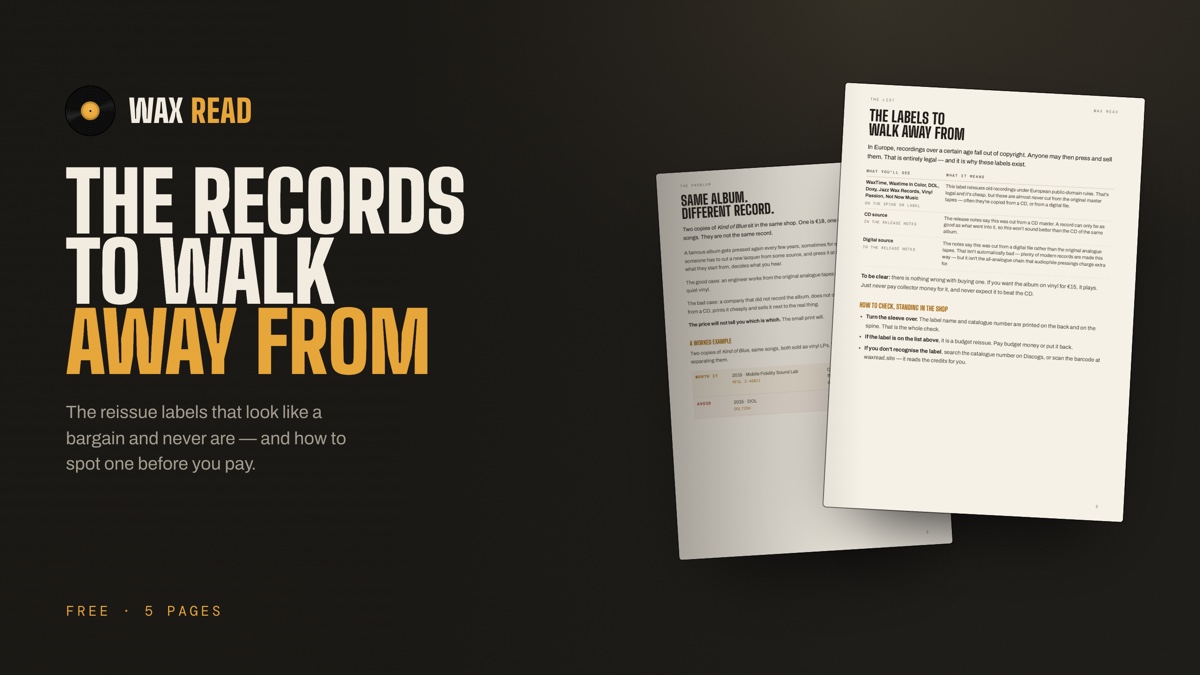
Free · 5 pages
The Records To Walk Away From
The reissue labels that look like a bargain and never are, how to spot one on the sleeve in ten seconds, and the names worth paying extra for.
Get it free →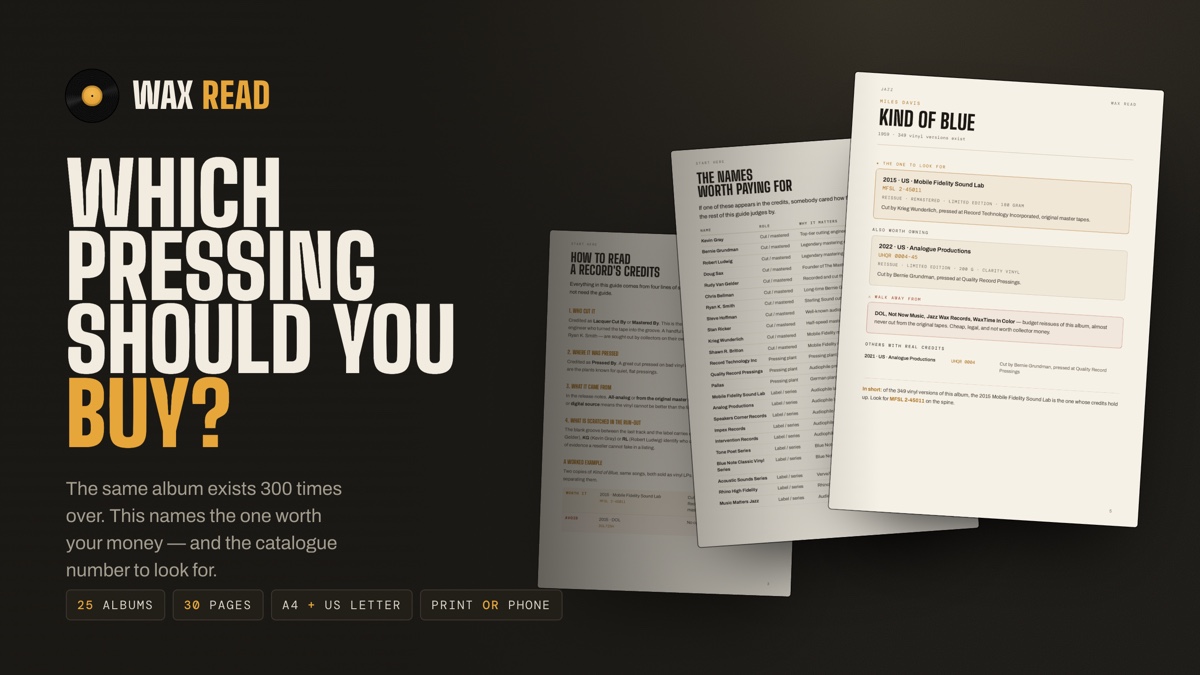
$15 · 30 pages · 25 albums
Which Pressing Should You Buy?
For 25 classic albums, jazz and rock: the pressing worth owning, the catalogue number to look for on the spine, and the cheap reissues to walk past.
Get the guide →The app
The app is free. The homework is $15.
The app
Free
- Scan or search any record on Discogs
- Who made it, and the budget-reissue warning
- What owners say about the pressing
- Cheapest copy for sale now
- No account, nothing to buy
Which Pressing Should You Buy?
$15one time
- 25 albums, a page each — Kind of Blue to OK Computer
- Which pressing to look for, and which to put back
- Written for the rack, not the armchair
- Printable PDF — works with no signal in the shop
- Yours to keep, no subscription
New to this? Start with the free 5-page one.
Questions
Good to know
I’m completely new to vinyl. Is this for me?
Especially for you. If you already know who cut your favourite reissue, Wax Read mostly tells you things you know. If you’re a year or two in and you’ve wondered why the same album costs €15 in one rack and €70 in another, that gap is exactly what this explains. There’s a short primer in the app too.
What is a “pressing”?
Every time a record is manufactured again, someone cuts a new master and a factory presses new copies. Each of those runs is a pressing. They can be years apart, made by different people, from different sources — so two copies of the same album can sound quite different.
Is it really free?
Yes — all of it, with no account and no limit. The only thing that costs money is the printable guide, and the app works perfectly well without it.
Does the barcode scanner work on my phone?
Camera scanning works in Chrome on Android. On iPhone, Safari can’t scan barcodes yet, so type the digits printed under the barcode instead — it does exactly the same thing. Searching the album name works everywhere.
Where does the data come from?
From Discogs, the big community music database: the credits printed on each release, the written reviews owners left about it, how many members own and want it, and live marketplace listings. Wax Read reads that and turns it into a verdict.
How does it decide a pressing is good?
From credits and owners, not star ratings. It looks at who cut and mastered it, from what source, and where it was pressed, then quotes the reviews that talk about the pressing itself. Stars are shown in small print only, because they mix up the music, the pressing and people’s gear. It’s a guide, not a replacement for your ears — and condition still matters more than any of it.
Is the price what the record is worth?
No. It’s the cheapest copy listed for sale right now, which is often the one in the worst condition, and shipping is extra. Always check the grade before buying.
Stop paying for rarity.
Check the next record before you buy it.
Check a record, free →